To expand from local SEO to national SEO, you should shift focus away from city-based signals and build authority across the country. You have to target broader search terms, improve site architecture, and earn strong backlinks that support nationwide reach.
The main point in national SEO vs local SEO is scale. Local SEO depends on maps and location keywords. National SEO depends on topical authority and non-geo keywords. You need a clear structure and strong content depth so search engines trust your website.
Well, in this guide, we have described a complete 9-step roadmap for this fact. Read this full 2026 guide to do it the right way.
The 9-Step Strategy to Expand From Local to National SEO
Here is your clear step-by-step national SEO plan. This roadmap helps you grow across the country without harming local strength. Strong national SEO strategies need careful implementation and regular measurement. Each step builds on the one before it.
Roadmap overview:
- Define your national offer and target markets
- Audit and protect local pages that already rank
- Expand keyword list with non-geo terms
- Build a pillar and cluster content map
- Create strong non-geo service or product pages
- Publish helpful content at scale
- Fix technical issues that block growth
- Earn national authority backlinks
- Track results and refine by market and search intent
Each step below explains what you should do and why it matters.
Step 1: Confirm National Readiness and Market Scope
Before SEO work starts, you should define what “national” means for your brand. National reach can mean nationwide shipping, remote service, or multi-city service coverage.
Your pages must match what you truly deliver. Strong SEO for a national business begins with a clear and honest scope.
Search demand at the national level is massive, which is why clear positioning matters. Studies show that about 53% of all website traffic comes from organic search, making search engines the largest source of visitors for most businesses.
Next, you have to decide on your direction. You can rank nationally for one main offer. Or you can target specific markets with selected focus areas. Market selection is very important.
Choose 3 to 5 priority segments, such as industries, product lines, or use-cases. This step helps you develop a national SEO plan without spreading yourself too thin.
Finally, set clear goals. You should track leads, demo requests, ecommerce sales, or branded search growth. Clear KPIs guide smart action.
Step 2: Preserve Local Presence While You Scale Nationwide
The safest way to grow is simple. You should add national layers on top of your local base, not remove it. To preserve local SEO while scaling nationwide, you must keep location pages active and clear.
National pages should target broad search intent. Local pages should stay focused on city-based searches.

First, protect your top location pages. Keep their content, rankings, and internal linking structure. These pages already bring traffic and leads. Do not merge or delete them without a strong reason. Also, keep your GBP profiles updated for each real location.
Next, prevent cannibalization. Cannibalization means two pages compete for the same keyword.
- Local page = geo intent, like “service + city”
- National page = non-geo intent, like “service,” “best service for X,” or “pricing.”
Add one simple internal linking rule. Local pages should link up to the national pillar page. The pillar page should link to relevant location pages. This structure keeps roles clear and strong.
Step 3: Broaden Keyword Research Beyond Geo Modifiers
National growth begins when you broaden keywords beyond “service + city” terms. You should focus on non-geo keywords across three intent categories: informational, commercial, and transactional.
According to Wonderful’s data, around 68% of all online experiences begin with a search engine, which means users often start with broad, non-location queries before narrowing their options.
Informational means users want answers. Commercial means users compare options. Transactional means users want to buy or request a quote. Strong national SEO keyword research always checks keyword difficulty and business value before final selection.
Start with your current data. Use tools like SEMrush or Ahrefs, or check Google Search Console. Pull your top local keywords, then remove city names. This step reveals national variants.
Build four keyword groups:
- Core service or product terms
- Use-case terms like “for industry” or “for problem.”
- Comparison terms like “best,” “A vs B,” or “alternatives.”
- Pricing terms like “cost,” “buy,” or “quote.”
Finally, review competitor gaps. Check which non-geo terms national competitors rank for, but your site does not.
Step 4: Build a Pillar + Cluster Content Map (Your National SEO Engine)
To compete at a national level, you need full topic coverage. You should create a strong pillar content strategy. This means one main page for each major service or category. These are called pillar pages. Each pillar must connect to many supporting pages called cluster pages.
This structure builds topical authority and supports your national SEO content strategy.
Start with 3 to 6 pillar pages. Choose areas that drive the most revenue. Each pillar should target a broad non-geo keyword.
For every pillar, map 8 to 20 cluster pages. These can cover FAQs, comparisons, use-cases, and “how it works” topics. Each cluster should answer one clear question or need.
Follow a simple internal linking rule.
- Cluster pages link to the pillar with natural anchor text variations.
- Pillar pages link back to top clusters and main conversion pages.
Strong topic clusters act as your national SEO engine.
In short, a pillar + cluster structure builds topical authority, which replaces proximity signals when moving from local to national SEO.
Step 5: Create Non-Geo Commercial Pages That Convert (Not Just Blog Posts)
National SEO is not only about blog content. Real growth often comes from strong non-geo commercial pages. You should create non-geo-targeted content that serves clear conversion intent.
These pages answer high-intent searches such as services, categories, solutions, and pricing. Smart national SEO strategies focus on revenue pages first.
Build or upgrade core service pages, category pages, and focused landing pages. Add “solutions for [industry]” sections if you serve specific markets. Include pricing pages and detailed case studies to show proof.
Add trust elements on each page. Use real reviews, clear outcomes, policies, and service or shipping coverage details. Show national relevance in honest ways, such as nationwide delivery, remote support, or partner networks. Avoid fake city claims. Clear value builds trust and sales.
Step 6: Strengthen On-Page SEO and E-E-A-T for National Competition
National search results are more competitive. You need strong on-page SEO for national SEO and clear E-E-A-T national SEO signals. E-E-A-T stands for Experience, Expertise, Authority, and Trust. These signals help search engines judge content quality and reduce thin content risk.
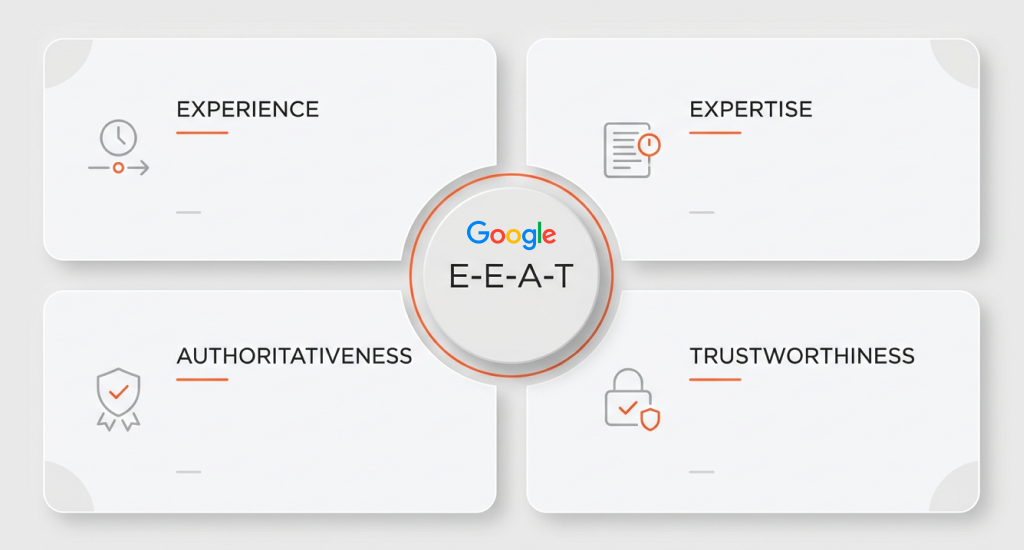
Start with a simple on-page checklist. Use clear titles and proper H1 and H2 headings. Add helpful FAQs. Apply basic schema markup where useful. Keep the structure clean and easy to scan.
Strengthen trust signals. Add author bios with real credentials. Include case studies and cite credible sources. Use real photos and data where possible. Maintain clear editorial standards.
Set a content update plan. Refresh local pages and pillar pages on a schedule. Do not publish and leave pages untouched. Regular updates support long-term authority.
Step 7: Upgrade Site Architecture for Scale (Navigation + Index Control)
National SEO grows faster when your website is simple for search engines to read. Strong site architecture for national SEO improves crawlability and indexation. Crawlability means search engines can access your pages.
Indexation means pages are stored and ranked. Clean navigation and smart internal linking help Google focus on your best content.
Recommended structure:
Home → Categories or Pillars → Clusters → Conversion pages
Review thin or weak pages. Merge similar pages or use noindex for low-value duplicates. This protects authority.
If you run an e-commerce site with filters, watch duplicate URLs. Use canonicals to show the main version of a page. A strong blog can also enhance site architecture when it supports pillars with clear links.
Step 8: Build Authoritative Backlinks From National Sites
To rank across the country, you must build authoritative backlinks from national sites. Strong national SEO strategies rely on trust signals from respected platforms. Backlinks act as votes of credibility. Brand mentions also help authority.
Use digital PR with clear value. Create linkable assets such as:
- Original data studies
- Free tools or templates
- “State of the industry” reports
Pitch trend insights, unique data, or expert commentary to journalists and bloggers.
Build partnerships with real associations, vendors, or integration partners. Scholarships can work, but only if legitimate. Quality matters more than volume.
Step 9: Analyze National Competitors and Measure the Rollout
National SEO is not a one-time task. You should analyze national competitors’ SEO on a regular basis and measure national SEO results with clear data. Set benchmarks first. Then expand what performs well and remove weak pages.
This steady process improves long-term visibility.
Start with a competitor snapshot. Review their pillar pages, link profile patterns, and content types. Check which SERP features they win, such as featured snippets or FAQs.
Tools like SEMrush or Ahrefs help with link and keyword data. Search Console shows your real search queries and impressions. Rank tracking tools show position changes over time.
Build a clear reporting plan:
- Track non-geo keyword groups by intent category
- Track conversions by landing page type, such as pillar, local, or blog
- Monitor cannibalization and fix it with internal linking or content consolidation
Measure, adjust, and scale with confidence.
Local SEO vs National SEO: What Actually Changes?
Local SEO depends on geography and proximity. National SEO targets a broad audience nationwide. The ranking signals change.
Proximity vs authority becomes the key shift. When you expand from local SEO to national SEO, you move focus away from map distance and build deeper content and stronger links. This is the core difference in national SEO vs local SEO.
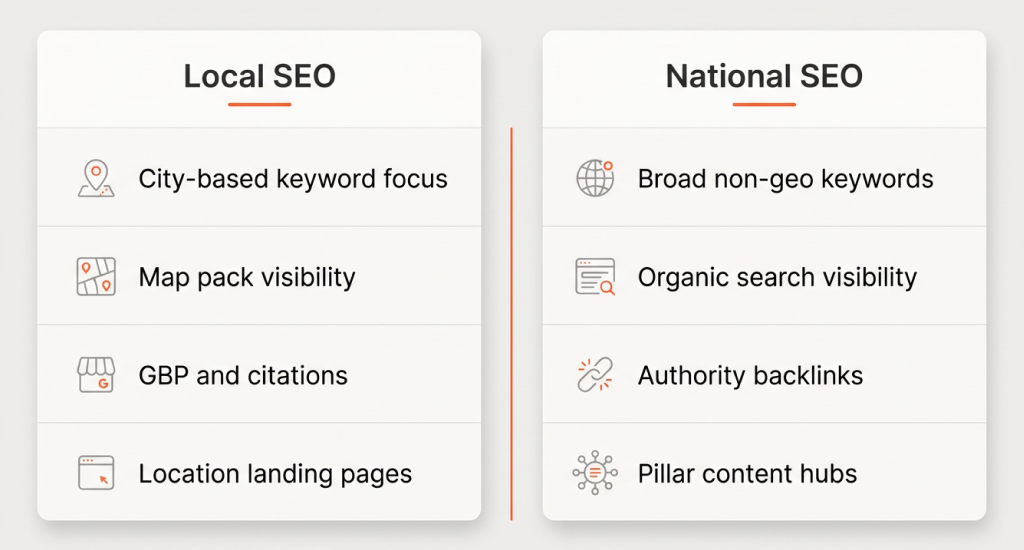
Local SEO prioritizes location relevance. You optimize local landing pages for “service + city” terms. Citations and GBP listings support visibility in map results. Organic traffic still matters, but GBP often drives calls and visits.
National SEO gives importance to topic coverage and content hubs. You use non-geo keywords and build brand trust. A stronger backlink profile supports organic growth at scale.
Here is the clear comparison:
| Signal | Local SEO | National SEO | What You’ll Do Differently |
|---|---|---|---|
| Ranking Driver | Proximity and location relevance | Authority and content depth | Shift focus from map signals to strong content hubs |
| Keywords | “Service + City” terms | Non-geo keywords | Broaden keyword research beyond city names |
| Main Visibility | GBP and local pack | Organic search results | Invest more in national organic pages |
| Content Structure | Local landing pages | Pillars and clusters | Build topic hubs with strong internal linking |
| Backlinks | Local directories and citations | National authority sites | Earn higher-quality editorial links |
End Note
Growth at the national level needs patience and a clear system. You must protect your local strength while you build broader authority. Focus on strong structure, deep content, trusted links, and clear measurement. Each step in this guide supports steady and safe expansion.
National visibility does not happen overnight. Follow the roadmap with discipline and review results often. When you apply the right strategy, your brand can grow across the country without losing its local foundation.