LLMs now act as text-mining engines that pull facts and buyer ideas from large data sets. Firms need this power when leads fall or ad costs rise. The best LLM AI for business turns raw data into sales words.
An LLM reads data, learns patterns, then writes clear text for ads, emails, and chat. This cuts work time and lifts profit. A weak model can hurt brand trust, so the best LLM AI for business includes marketing matters.
Today, we list 20 top LLM AI tools. This guide shows how each one fits real business goals. If you want more sales, a steady brand voice, and better ad results, this blog is for you.
Key Takeaways
- Choose LLMs based on business goals, not hype or popularity.
- Marketing success depends on model fit, cost, and integration.
- Free LLMs suit testing, paid models support revenue work.
- Data rules and privacy needs shape the right AI choice.
- The best LLM grows with your team and workflow.
What Are LLMs?
Large Language Models, or LLMs, are smart computer systems that read huge amounts of text. They learn how words work together, then use that skill to write, reply, and give clear answers.
An LLM can write emails, ads, chat replies, and product text. It does this by using patterns from books, sites, and business data. This helps brands talk to people in a natural way.
When organizing AI-generated content across your site, understanding how many categories to use helps structure your content library effectively for both users and search engines.
For a business, an LLM works like a digital strategy consultant and writer. It saves time, keeps tone steady, and helps teams share ideas fast across ads, pages, and support chats.
Here’s why LLM matters:
- Helps teams write sales messages with clear and simple words.
- Cuts time spent on emails, ads, and chat replies.
- Keeps brand voice steady across every customer touch point.
- Helps small teams work like much larger ones.
- Uses data to shape better offers and ad copy.
- Supports quick replies that help buyers trust the brand.
20 Best LLM/AI for a Marketing AI Startup
Picking the right LLM AI can determine how your brand speaks, sells, and supports buyers. A good match can lift sales and save time, while a poor one can waste both. Here, we have listed 20 options. Check their details, compare their strength, and match each one with your business needs.
1. OpenAI – GPT-5.1
- Strength: High text quality with strong logic across many business tasks
- Use case: Sales pages, ads, emails, support chat, and blog content
- Integration: API, ChatGPT, plugin system, and custom business tools
- Best for: Brands that need fast, reliable, and high-quality AI
GPT-5.1 from OpenAI works as a full writing engine for modern companies. It helps teams create ads, emails, product pages, and chat replies with a smooth tone and strong clarity that fits both sales and support work.
Across many industries, firms rely on this model since it keeps brand voice steady while handling large content loads. Strong language skills and broad data use help teams keep output sharp across marketing, help desks, and lead flows.
2. Anthropic – Claude 3.7 Sonnet
- Strength: Safe tone, clean structure, and strong control over long text
- Use case: Brand rules, help pages, long blogs, and policy text
- Integration: API, web interface, and partner business platforms
- Best for: Companies that need safe and well-controlled brand writing
Claude 3.7 Sonnet from Anthropic focuses on clear and careful business text. It suits brands that publish long guides, trust pages, or customer support content where tone and clarity must stay stable across many sections.
Many firms choose this model since it avoids risky language while still giving useful answers. That balance helps marketing and support teams protect brand trust while sharing detailed information with buyers.
3. Google – Gemini 3
- Strength: Strong link with search data and fast access to live information
- Use case: Ads, product pages, Best LLM for market research, and data-based content
- Integration: API, Google Workspace, and Google Cloud tools
- Best for: Teams that rely on Google data and live web insights
Google’s Gemini 3 blends language skills with search and data tools. It helps brands shape ads, reports, and web pages with fresh facts that support smart offers and more accurate messaging.
To maximize your visibility in local search results, explore our Google Local Pack Statistics (2025 Study) to understand the impact of ranking in local results.
Most marketing teams value this system since it links text with live data. That mix helps ad teams, writers, and product managers keep content current, useful, and tied to real market trends. When integrated with a comprehensive Organic SEO Service, AI-generated content can be optimized to rank higher and drive consistent organic traffic.
4. Meta – Llama 3.x
- Strength: Open source design with full fine-tuning and system control
- Use case: Custom brand chat, private sales bots, and internal tools
- Integration: API, self-hosted servers, and custom AI stacks
- Best for: Tech teams that want full model control
Meta Llama 3.x gives brands full freedom over their AI setup. Teams can run it on their own servers, shape its tone, and decide how it uses data without any outside platform rules.
This open design helps firms build private chat tools, sales bots, and support systems that align with their brand voice. It also suits companies that must keep data inside their own secure systems.
5. Perplexity – Retrieval-First Assistants
- Strength: High accuracy with citation-based answers from real web sources
- Use case: Market research, brand checks, and content ideas with proof
- Integration: API access and web widgets for internal tools
- Best for: Teams that need trusted sources in AI-written content
When facts matter more than style, Perplexity gives an edge. Each reply links to credible sources, so writers and marketers can substantiate claims, cite data, and avoid weak or fabricated details.
Blogs, reports, and pitch decks stay safe with this system. Since it shows where each answer comes from, editors can quickly verify facts and maintain brand trust across all public pages.
6. DeepSeek – R1 / V3.x
- Strength: Strong logic with open access models and low cost
- Use case: Sales bots, campaign agents, and automated task flows
- Integration: Web app and API built for agent-driven systems
- Best for: Teams that build in-app AI workers
Some brands want AI that acts, not only writes. DeepSeek fits that role since it can follow steps, run tools, and complete tasks within apps, which aligns with sales flows and campaign systems.
Cost also remains lower than that of many closed platforms. That makes it useful for product teams that test new ideas quickly, build many bots, and run high-volume tasks without significant spending.
7. Microsoft – Copilot / Azure OpenAI
- Strength: Enterprise-grade security with full Office app support
- Use case: Sales decks, Excel reports, Word files, and team notes
- Integration: Built into Microsoft 365 with Azure API access
- Best for: Large firms that run on Microsoft systems
Daily office work moves faster with Copilot since it sits inside Word, Excel, and Teams. Staff can write, edit, and analyze data in the same place where real work already happens.
IT teams value it for data control. Azure rules and company policies stay active, so firms can use AI across files, chats, and reports without fear of data leaks or rule breaks.
8. Cohere – Command Family
- Strength: Strong search, text embedding, and multi-language skills
- Use case: Smart site search, local ads, and brand content
- Integration: API with managed enterprise tools
- Best for: Teams that run global and data-heavy marketing
Large content libraries need AI that can link text with user intent. Cohere fits this need by helping brands build search tools and content engines that match what buyers ask on sites.
Language support also stands out here. Global brands can keep one voice across many regions, which helps ads, emails, and pages stay clear and on brand in different markets.
9. Mistral – 7B / Instruct
- Strength: Strong quality with low cost and fast model response
- Use case: Brand chat bots, ad helpers, and high-volume content tasks
- Integration: Self-hosted models or third-party API platforms
- Best for: Startups and dev teams that need speed with low spend
Small teams often run into budget limits before they hit traffic limits. Mistral fits that gap by giving sharp text output without heavy server cost, which helps young brands scale support and sales copy.
On local machines or cloud servers, this model stays light and quick. That makes it useful for high message loads, simple brand bots, and custom marketing tools where speed matters more than complex logic.
10. Aleph Alpha – Luminous
- Strength: Strong data control with full focus on European privacy rules
- Use case: Secure company knowledge, public sector tools, and RAG systems
- Integration: Hosted APIs and private enterprise setups
- Best for: Regulated industries and sovereignty-focused organizations
In fields where data rules block most cloud AI, Aleph Alpha offers a safe path. It keeps data inside approved regions, which suits banks, government teams, and firms that must meet strict privacy laws.
Rather than open public models, this system centers on closed and protected setups. That lets firms build search, chat, and document tools over private files without risk of outside data access.
11. AWS Bedrock
- Strength: One API to access many top AI models with full control
- Use case: Secure AI apps, cloud-scale deployment, and model testing
- Integration: Native links to S3, Lambda, SageMaker, and AWS tools
- Best for: AWS-based enterprises that need many model choices
Large cloud teams value choice, and Bedrock gives it. Through one AWS service, firms can use models from several AI vendors while keeping billing, access, and control in one familiar system.
Security teams also gain peace of mind here. Since Bedrock works inside AWS rules, data stays under company control, which suits banks, health firms, and any group with strict cloud policies.
12. Databricks – Dolly
- Strength: Strong data control with full model training and tracking tools
- Use case: Internal AI helpers, analytics bots, and data-driven chat
- Integration: Databricks platform with API based pipelines
- Best for: Data engineering teams that want full AI lifecycle control
Dolly fits best where data already lives inside Databricks systems. Teams can tune models on their own tables, logs, and reports, which helps firms build AI that speaks in their business language.
Instead of a simple chatbot, this setup supports full data workflows. That helps analytics teams link AI with dashboards, customer data, and internal tools for deeper business insight.
13. Hugging Face – Model Hub & Inference API
- Strength: Huge model choice with strong community and test tools
- Use case: Model tests, quick AI trials, and hybrid AI stacks
- Integration: Inference API and Transformers SDK
- Best for: Teams that want to test many models before the final choice
Some teams do not want to lock into one AI too early. Hugging Face gives access to many open and paid models, so teams can try ideas, compare results, and test speed or cost with ease.
Engineers also use it to mix open and private models in one setup. That helps brands build flexible AI stacks, where each task uses the model that fits best instead of one fixed option.
14. Salesforce – Einstein GPT
- Strength: Deep CRM link with full control over sales and service data
- Use case: Sales emails, lead notes, and customer record summaries
- Integration: Salesforce plugins and platform APIs
- Best for: Sales and marketing teams that live inside Salesforce

Einstein GPT works where deals already move, inside Salesforce. Sales teams can draft emails, review leads, and update records with AI help without leaving the CRM that holds all client data.
For managers, this saves hours each week. Reports, notes, and follow-ups take less manual work, which helps teams focus on closing deals instead of typing and copying between tools.
15. H2O.ai – H2O GPT
- Strength: Clear model control with strong explainability and tracking
- Use case: Data reports, marketing insights, and controlled AI deploys
- Integration: On-prem and cloud MLOps systems
- Best for: Enterprises that need AI decisions they can explain
In some firms, AI must show how it reached a result. H2O GPT supports this need by giving clear model logs and decision paths, which suit finance, health, and regulated marketing teams.
Data teams also value their deep control tools. They can manage models, check output quality, and keep full audit trails while still using AI to shape reports, forecasts, and customer insights.
16. MosaicML – Custom Models
- Strength: Full model control with strong cost and data tuning
- Use case: Brand chat, product help, and domain-focused AI
- Integration: MLOps pipelines with hosted or private deploys
- Best for: Teams with rich data and strong engineering skills
Brands with unique data often outgrow general AI. MosaicML lets them build models that learn from their own files, chats, and product text, which leads to more accurate and on-brand replies.
Cost also stays under control here. Since teams shape how the model runs, they can tune size, speed, and data use to fit real workloads instead of paying for unused AI power.
17. Jasper / Writer – LLM Content Platforms
- Strength: Easy tools with strong brand control and team features
- Use case: Blog posts, ad text, and social content at scale
- Integration: CMS links, API access, and Zapier flows
- Best for: Marketing teams without in-house AI developers
Not every team wants to touch raw AI prompts. Jasper and Writer give ready-made workspaces where marketers can plan, write, and review content with brand rules built right into each screen.
Speed also plays a big role here. With templates and shared work areas, teams can push many campaigns at once without tech help, which suits agencies and busy in-house marketing groups.
18. Surfer / Semrush – SEO AI
- Strength: Keyword data and AI writing in one workflow
- Use case: Search focused blogs, content briefs, and page edits
- Integration: CMS plugins and SERP tracking tools
- Best for: SEO teams that need fast, optimized content
Search teams care more about rank than style. Surfer and Semrush use live keyword data to guide each line of text, which helps pages match what users type into search engines.
For e-commerce brands, pairing SEO AI tools with specialized e-commerce SEO strategies ensures product pages rank competitively and convert visitors into customers.
Writers also gain clear direction here. Instead of guessing topics, they follow real search signals, so blogs, guides, and landing pages hit the right terms that bring traffic and leads.
19. Zapier AI – Workflow Glue
- Strength: App links that turn AI text into live actions
- Use case: Auto post content, update leads, and sync campaigns
- Integration: Connectors to thousands of SaaS tools
- Best for: Teams that want automation without heavy tech work
Zapier AI works behind the scenes, not on a blank page. It takes AI output and sends it into email tools, CRMs, and content systems, which helps campaigns move without manual copy steps.
To ensure your automated systems run smoothly, Website Maintenance, Security, and Back-up services protect your integrations and prevent workflow disruptions.
Marketing ops teams use it to save hours each week. Once set, leads, posts, and messages flow on their own across apps, which keeps campaigns active even when teams stay small.
20. Creative & Media LLM Hybrids
- Strength: Fast text, image, and video creation in one system
- Use case: Ads, thumbnails, social clips, and promo visuals
- Integration: APIs and plugin links to ad and CMS tools
- Best for: Creative teams that need visual content at scale
Visual teams no longer start from blank screens. Tools like Runway, Midjourney, and Firefly use text prompts to make images and videos, which speeds up ad design and social post creation.
When combined with professional Video Marketing, AI-generated visuals can be refined into high-quality campaigns that drive engagement and conversions.
Campaigns also gain more options. Marketers can test many looks and styles fast, then pick the best one for each channel, which helps ads stay fresh without large design teams.
How to Choose the Best LLMs for Your Business?
Choosing the right LLM is a business decision, not a tech trend choice. Each model fits a different job, budget, and team skill level. This framework helps you judge options based on real needs, not hype or brand noise.
Use-Case Specificity
Start with the exact job you want the LLM to do. Some models suit sales text, others research, agents, or internal tools. Clear use cases prevent wasted spend and poor results across marketing, support, or data work.
Integration Ecosystem
Where your tools live matters. Google-first teams gain more from Gemini. Microsoft-based firms fit Copilot better. Standalone or open models suit custom stacks.
If you’re building custom AI integrations into your website, expert Web Design & Development Service ensures seamless implementation across your digital infrastructure.
Cost vs Performance
Higher cost does not always mean better output. Lightweight or open models often handle high-volume tasks well. Match model strength to task value, not prestige, to maintain healthy margins at scale.
Data Privacy & Compliance
Some businesses must keep data inside regions or private systems. Regulated fields need strong control, audit trails, and hosting options. Choose models that match your legal and data safety limits.
Ease of Use vs Customization
No-code tools help fast-moving teams. Custom models suit firms with engineers and unique data. Pick based on team skill, time limits, and long-term control needs.
Free vs Paid LLM Options
Small firms often start with free AI to test ideas and save cash. Search terms like best LLM AI free and best AI for business free show this need. Still, free tools and paid tools serve very different business goals.
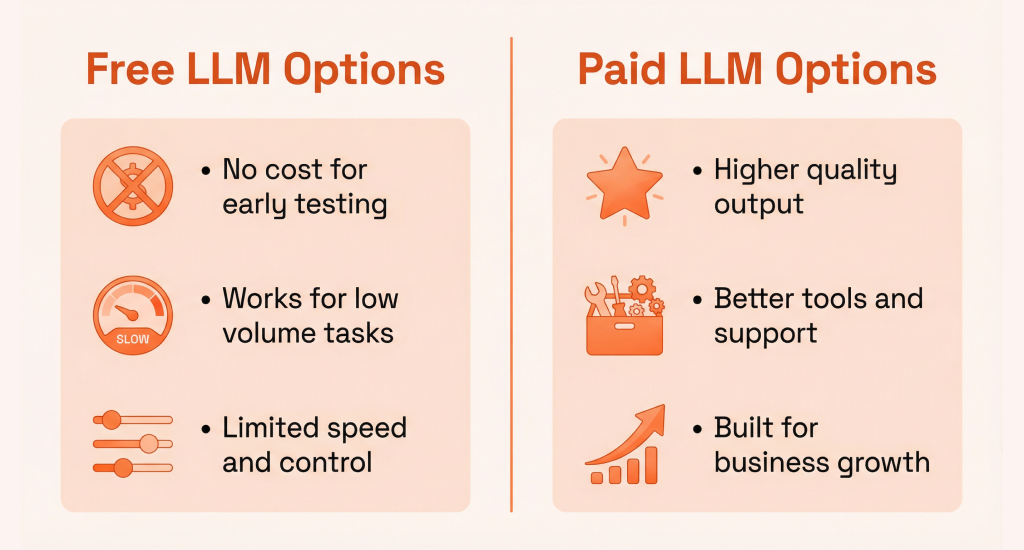
Free vs Paid LLM Comparison
| Type | Examples | Cost | Limits | Best Use |
|---|---|---|---|---|
| Free LLMs | Llama, Gemini Free | $0 | Usage caps, fewer features | Early tests, small tasks |
| Paid LLMs | GPT-5.1, Claude, Copilot | Monthly or usage-based | Cost adds with scale | Sales, marketing, support |
| Open Models | Mistral, DeepSeek | Low infrastructure cost | Setup needed | Custom business tools |
Free LLMs suit small teams that want quick tests or light content work. They help with drafts, ideas, and basic chat needs. Limits appear fast when volume grows or brand control matters.
Paid models earn value when work ties to revenue. Better support, speed, and control help ads, sales copy, and customer chat perform well. Hidden costs can include API use, token limits, hosting, and setup time.
End Note
LLMs now sit at the center of modern business and marketing work. The right choice can lift sales, cut effort, and protect brand trust. A wrong choice can waste budget and slow teams across daily campaigns and customer communication channels.
Use this guide to match goals, tools, and limits before you commit. Think about use case, cost, data rules, and team skills. The best LLM fits your workflow and grows with your business without risk, waste, delays, friction, or lock-in.