One small word on an address can change mail delivery. Many readers stop when they see STE and feel confused. If you have ever asked what “STE” is in an address, this guide gives a clear answer using simple words and real meaning.
So, what does STE mean in an address? STE is the short form of Suite. A Suite is a specific room or office inside a commercial building. The STE abbreviation works as a location identifier for correct mail delivery.
Address details matter every day. A correct Suite line helps USPS staff deliver mail fast and right. This blog explains the meaning of STE, examples, and the proper format step by step. So, read this blog to stay safe from address mistakes and delays.
Key Takeaways
- STE is the USPS-approved abbreviation for Suite in addresses.
- STE identifies a specific office inside a commercial building.
- Using STE helps prevent mail delays and delivery errors.
- STE should appear after the street name on the same line.
- Suite numbers guide USPS carriers to the correct internal location.
What Does STE Mean in an Address?
STE is the official USPS abbreviation for the word Suite. When people ask what STE is in an address, the answer stays simple. STE shows a specific Suite inside a building used for business purposes.
A Suite is a separate space inside a larger building. It may be an office, clinic, bank branch, or company room. USPS groups this under USPS Address Unit Types for clear mail delivery.
The suite short form STE appears after the street name on a commercial address. It tells mail carriers where the business is inside the building, not outside on the street.
STE appears mainly on a commercial address. Homes and apartments usually use other unit labels. Business buildings often hold many companies at one street number.
Without STE, mail may stop at the lobby or front desk. This situation causes delays or lost letters. STE avoids this problem by pointing to the right internal space.
Why STE Is Used in Mailing Addresses
The STE abbreviation keeps each delivery address line clear. USPS uses strict address formatting so carriers reach the right location identifier inside large buildings.
- Helps carriers locate the exact Suite without asking building staff.
- USPS rules keep address unit names consistent across all states.
- Street address shows the building; STE shows the internal office location.
- Reduces delivery delay inside busy commercial buildings.
- Helps sorting machines read addresses with fewer errors.
What Does STE 200 Mean?
Many readers ask, What does STE 200 mean on an address. STE 200 refers to Suite 200, a specific office within a commercial building. Large buildings often hold many businesses. Each one needs a unique internal address. Suite 200 helps separate one office from others in the same place.

This format clarifies what “STE” means in the address. The number shows the Suite position, often based on floor or layout rules. For example, Suite 200 may sit on the second floor. Suite 105 may sit on the first floor. Each number guides mail to the correct door.
Here is a practical example of an internal address format:
750 Oak Street, STE 200, Phoenix, AZ 85001
In this case, Oak Street shows the building. STE 200 shows the exact office inside it. USPS uses this format to ensure smooth delivery within every commercial building.
How to Properly Format an Address with STE
Correct STE placement helps USPS deliver mail to the right office without delay. Many beginners ask where STE belongs. Under USPS postal formatting rules, STE appears on the delivery address line. It is right after the street name and number.
The street address always comes first. The suite number follows it on the same line. This order helps mail systems read the address correctly. STE should never appear before the street name or on a separate line for standard business mail.
STE works as an office location marker. It tells the carrier where the business is located within the building. A clean delivery address line improves speed and accuracy for commercial mail.
Key formatting rules to remember:
- Write the street number and street name first.
- You must add STE and the suite number after the street name.
- Keep everything on one delivery address line.
- You should use capital letters for better postal scanning.
- Avoid extra symbols or commas inside the line.
This layout answers what STE is in the address example in the simplest form. Also, it helps USPS systems process mail faster.
Example 1: Business Address with STE
- John Doe
- 123 Main St STE 200
- Dallas TX 75201
In this case, STE 200 shows the exact suite number inside the building on Main Street. The carrier knows which office to visit after reaching the address.
Example 2: When STE Comes After the Street Name
- SmartTech Solutions
- 789 Market Blvd STE 450
- San Diego, CA 92101
Here, the street name comes first. The suite number follows right after. This format matches USPS rules and avoids delivery errors. These examples show correct STE use for any office location.
STE vs Suite vs Unit vs #: What’s the Difference?
Many address labels look similar but mean different things. People often mix them up and cause mail errors. This section about suite vs ste vs unit explains which term fits which place and why correct address components matter.
STE vs Suite (Same Meaning, Different Style)
STE and Suite share the same meaning. Both point to a Suite number inside a business building. The difference stays in style, not purpose.
STE is the USPS-approved suite short form. Postal systems recognize it fast during mail scans. This makes STE the safer choice for business mail. The suite written in full is still correct. Many companies use it on signs or letterheads. USPS accepts it, but STE works better for machine-read addresses.
When accuracy matters, STE stays the best option. It follows USPS unit types and keeps address components clear for carriers.
STE vs UNIT
UNIT works as a broad label. It can refer to apartments, condos, storage spaces, or small offices. Because of this, UNIT fits many property types.
STE has a narrow role. It applies mainly to offices or professional spaces inside commercial buildings. Banks, clinics, and agencies often use STE.
USPS separates these labels by purpose. UNIT fits mixed-use or residential spaces. STE fits business locations only. Using UNIT for an office may confuse carriers. Using STE helps them expect a business suite, not a home space.
STE vs # (Pound Sign)
The # symbol appears often in online forms and casual writing. People use it as a shortcut for a suite number or unit label. USPS does not favor the # sign for business mail. It lacks clarity during address scans and mail handling.
STE gives a clear signal that the address leads to a business Suite. It really improves delivery speed and reduces errors. For professional mail, STE works better than #. It follows USPS unit types and keeps address components clean and precise.
Should You Use STE or Unit in an Address?
Many people wonder whether you should use ste or unit in an address. Using the correct label avoids mail errors, delays, or confusion. This section explains when to use STE and when UNIT fits better.
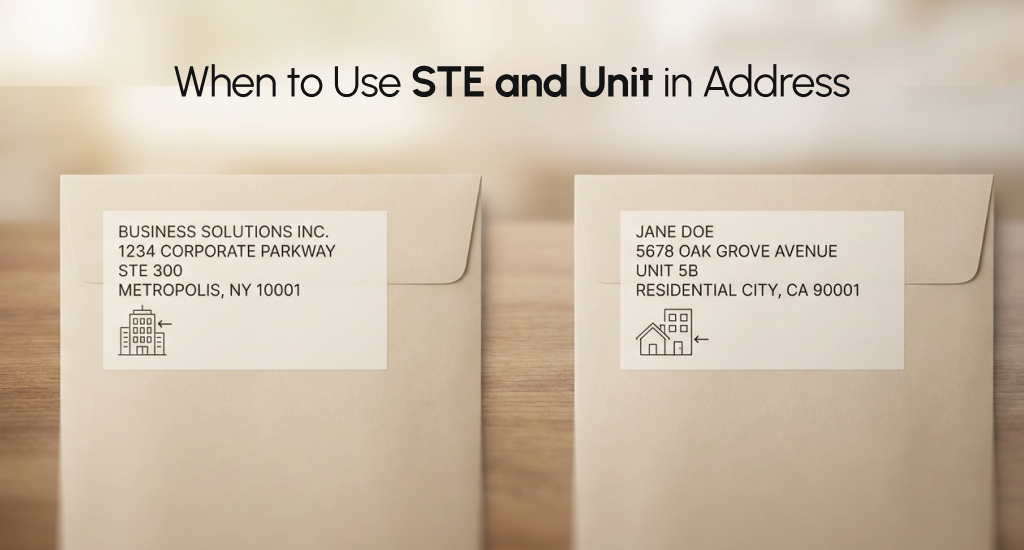
When to Use STE
STE works for businesses inside commercial buildings. Offices, clinics, and agencies should always list the suite number using the STE abbreviation.
Example:
- Bright Solutions
- 456 Corporate Ave STE 300
- Houston TX 77002
Using STE clearly identifies the internal office. USPS standards recognize it for fast and accurate delivery. STE signals to carriers that the mail goes to a specific office or business suite, not just the building lobby. You should always use STE for commercial addresses, even if the suite seems obvious.
When to Use UNIT, APT, or
UNIT is for apartments, condos, or storage spaces. Residential addresses follow these address unit types instead of STE.
Example:
- Emily Clark
- 102 Maple St UNIT 5B
- Orlando FL 32801
APT or # also works for homes. UNIT is more formal, while # is informal or for online forms. These labels guide carriers to the right internal space in residential or mixed-use buildings.
Practical Tips for Choosing the Right Label
- Check if the address is commercial or residential before labeling.
- For offices, clinics, or banks, use STE with the correct suite number.
- For apartments or condos, you should use UNIT, APT, or # as appropriate.
- Avoid mixing labels; STE on a home address or UNIT for a business may confuse USPS carriers.
- Correct usage ensures faster mail handling and reduces the risk of lost or misrouted letters.
The right term helps ensure your mail is accurate, professional, and on time, while meeting USPS guidelines for every address type.
Where Exactly Should STE Appear in Your Address?
Many people ask what the proper way to format an address with STE is. USPS has clear rules: the STE abbreviation should appear on the same delivery address line as the street address, right after the street number and name.
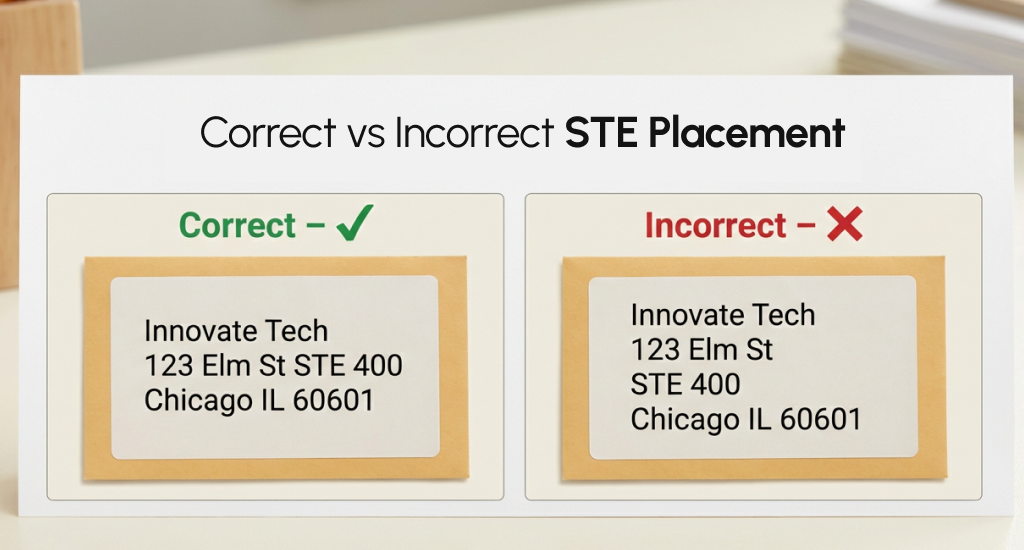
Placing STE on a separate line can confuse sorting machines. Mail might get delayed or misrouted because automated systems scan addresses line by line. Correct placement ensures USPS reads the suite number as part of the delivery address, not as an extra note.
Correct vs Incorrect Example
Correct:
- Innovate Tech
- 123 Elm St STE 400
- Chicago IL 60601
Incorrect:
- Innovate Tech
- 123 Elm St
- STE 400
- Chicago IL 60601
In the correct example, the suite number follows the street address on the same line. It clearly indicates to carriers which internal office or room should receive the mail. In the incorrect example, separating STE can slow delivery or confuse machines.
Tips for Perfect STE Placement
- Always place the street number and name first, followed immediately by STE and the suite number.
- Keep the delivery address line uncluttered; avoid commas or extra symbols inside it.
- You should capitalize STE and the suite number for easier machine reading.
- For commercial mail with multiple suites, always try to include the exact suite number to prevent misdelivery.
- Double-check addresses before sending to match USPS guidelines for fast and accurate delivery.
Common Mistakes People Make with STE
Many people think using STE is simple, but small errors can delay mail or confuse carriers. Following proper USPS guidelines helps avoid common address errors when sending to businesses.
Using # Instead of STE
Some people write the # symbol for a suite number, like #200. While casual forms accept it, USPS prefers the ste abbreviation for commercial addresses. Using # can confuse sorting machines and slow delivery.
Putting STE on a Separate Line
A frequent mistake is placing STE on its own line below the street address. USPS rules require the suite number to stay on the delivery address line after the street name. Separating it can cause misrouting.
Adding Punctuation
Writers sometimes use STE. 200 with a period. USPS discourages punctuation inside the suite short form. Extra punctuation can cause automated sorting systems to misread the address, delaying mail or sending it to the wrong office.
Leaving STE Out Entirely
Skipping the suite number when a building has multiple offices is a major error. Carriers may leave mail at the wrong office or in the lobby. So, including STE ensures the unit identifier is clear and accurate.
Using STE for Residential Addresses
Some people mistakenly use STE for apartments or condos. STE is for commercial offices only. For residential addresses, labels like UNIT, APT, or # should be used. Incorrect labeling can confuse carriers and cause delivery delays.
Incorrect Placement of STE Within the Line
Another mistake is placing the suite number in the middle or at the end of a multi-line address incorrectly. STE must follow the street name directly on the delivery address line. Wrong placement may slow sorting machines or cause misdelivery.
You should use STE the right way to avoid mail delays. Always try to put it after the street name, skip punctuation, add the suite number, and reserve STE for business addresses only.
USPS Address Standards for STE (Simplified)
USPS uses specific rules and codes to standardize every address. It ensures mail reaches the correct building and internal office quickly, even in large commercial complexes.
The STE abbreviation is an official secondary unit designator under USPS Address Unit Types. It identifies a suite number or internal office within a building. Using STE in the correct format keeps addresses clear, professional, and easy for carriers to read.
Following the suite short form and USPS guidelines prevents misdelivery, sorting errors, and delays. The system applies the same rules nationwide, so every office using STE is recognized consistently.
For those who want official details, USPS Publication 28 explains all standardized address formats and unit identifiers: USPS Publication 28.
Using STE correctly is simple but very important. It ensures your mail follows USPS standards, stays professional, and reaches the right suite without mistakes.