Many people forget that Google+ once played a big role in online growth. Google Plus for SEO was not only about sharing posts; it gave websites a direct link to Google’s search power. Even though the consumer version closed in April 2019, the lessons it left behind are still valuable.
When a platform comes from Google itself, it often carries hidden advantages. Google Plus helped websites appear more visible in search results and built stronger trust with audiences. These benefits mattered to businesses of every size, from small shops to larger companies.
Looking back shows how much businesses gained from Google+. They enjoyed better rankings, stronger brand visibility, and improved reach across audiences. In this blog, we will explore the key SEO advantages that made Google Plus(+) so powerful.
Key Takeaways
- Google Plus offered fast indexing, improved visibility, and enhanced brand authority in search.
- Authorship and publisher markup boosted credibility, trust, and click-through rates in SERPs.
- Integration with Google services streamlined content sharing, supporting SEO and audience engagement.
- The shutdown required businesses to shift to modern tools like Google Business Profile and social media.
- Focusing on E-E-A-T, AI-driven search, and communities maintains SEO in today’s landscape.
Historical Context of Google Plus and SEO
Google+ was launched in June 2011 as Google’s direct competitor to Facebook. It was designed to bring people closer by connecting social interaction with Google’s strong search system.
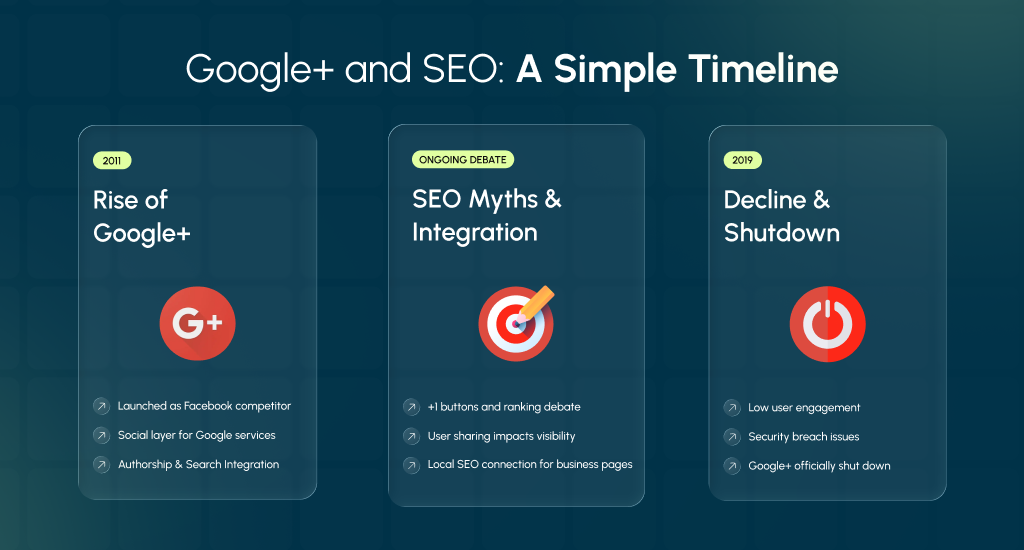
Unlike other platforms, Google had the advantage of linking Google+ with tools people already used every day, like Gmail, YouTube, and Google Search. To make the platform attractive, Google built features like Circles, Communities, and Hangouts.
This strong integration also meant posts on Google+ could appear in search results, which gave businesses extra SEO benefits. For many companies, it was a golden opportunity to boost visibility and authority.
Despite these efforts, Google+ never achieved steady growth. Monday Digital found an article from Wikipedia that showed that 90% of user sessions on Google+ lasted less than five seconds. On top of that, a serious privacy bug exposed profile data of up to 500,000 accounts to developers.
These issues, combined with low engagement, resulted in the shutdown of the consumer version in April 2019. Still, its history leaves valuable lessons about how social platforms can influence SEO.
Here are some of the most important highlights about Google Plus and its role in SEO:
Launch as a Facebook Competitor
Google+ entered the market as a bold move against Facebook. It had similar features to posting updates and sharing photos. Also, it carried the advantage of being directly tied to Google’s ecosystem.
Deep Integration into Google’s Ecosystem
Google linked Google+ with Gmail, YouTube, and even search results. It meant businesses that stayed active could increase their chances of appearing in top search rankings.
Timeline of Rise and Shutdown
- 2011: Google+ launched with high expectations.
- 2013-2014: Growth slowed; users signed up but did not engage much.
- 2018: A major data leak exposed user details.
- 2019: Google shut down the consumer version because of low use and security issues.
Privacy Concerns and Low Activity
The privacy bug that affected nearly half a million accounts damaged trust. At the same time, low activity with most sessions under five seconds showed that users never truly adopted the platform.
Lessons for SEO Today
Even though Google+ ended, it proved how deeply a social platform can influence visibility in search results. For SEO experts, the key takeaway is that Google values platforms that connect people with useful content.
Core SEO Advantages of Google+
Google+ gave unique SEO benefits during its active years. Because it was owned by Google, posts and profiles often had a direct effect on how quickly content appeared in search. Let’s break down the main advantages one by one.
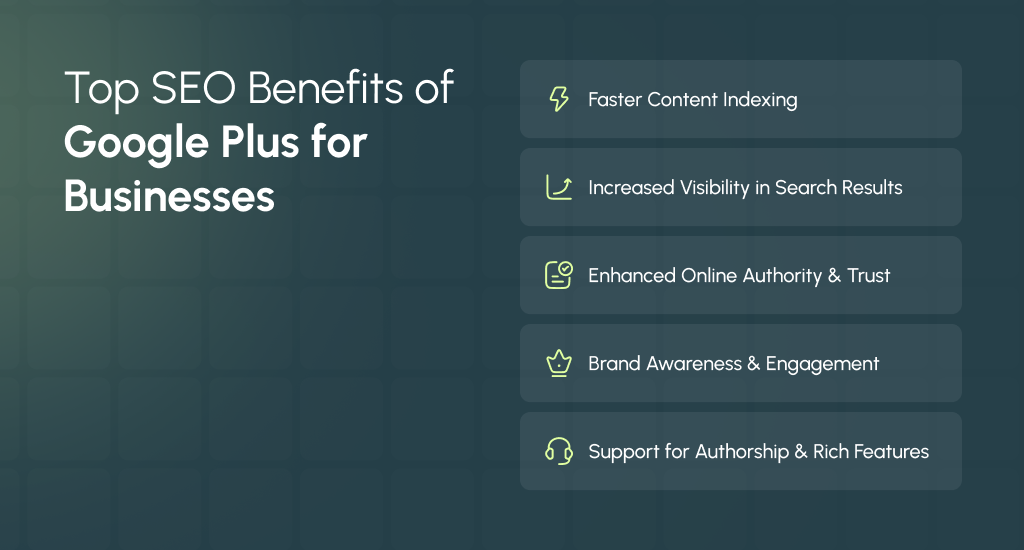
Faster Content Indexing
One of the biggest strengths of Google+ was speed. Posts made on the platform were often indexed by Google much faster than those on Facebook or Twitter.
- Fresh updates had a better chance of showing up in search results almost instantly.
- Being a Google-owned service meant fewer delays and restrictions for crawling and indexing.
Generally, content shared on Google+ was crawled within minutes, while on other platforms it often took hours or even days. For businesses, it meant time-sensitive posts like offers or announcements could appear right when people searched for them.
Increased Visibility in Search Results
Google+ content often appeared directly inside search result pages. Profiles, posts, or previews sometimes showed up when people searched for brands or related topics.
- Brand name queries could show the Google+ page right in the results.
- Posts shared on Google+ might rank above regular website content for some searches.
Because Google had features that tied Google+ to search personalization, content from the platform could look more relevant to users who were signed in. It helped businesses get organic exposure (people finding them without ads).
Enhanced Online Authority & Trust
Active Google+ profiles built credibility. Features like Authorship (linking content with a profile) and visible profile info made Google believe the author was real and active.
- Profiles with social signals like +1s, followers, or engagement had more weight in trust.
- Authentic content could result in better rankings over time because Google favors trusted sources.
For example, we found out in “Step-by-Step SEO: How to Set Up Google+ Authorship” from Search Engine Journal, one case study showed that adding authorship data and rich snippets increased search clicks by 150 percent during a one-month test.
Brand Awareness & Engagement
Google+ provided a space for companies to talk directly with their audience. Pages could share posts, reply to comments, and create a community around their products or services.
- Regular interaction helped people remember the brand better.
- Sharing links from blogs or websites on Google+ could bring visitors back to those sites.
Because people saw the brand in different places (profile, search, posts), the overall visibility grew. It helped even small brands to build recognition.
Support for Authorship & Rich Features
Google experimented with extra features using Google+. Authorship tags, rich snippets, and profile info sometimes appeared in search results. These features could make search listings more appealing.
- Listings with author photos or bylines stood out in search.
- Rich snippets might include extra lines or images, raising click interest.
Because most users do not go past the first page of search results, having rich features helps businesses get noticed early.
Features of Google Plus That Boosted SEO
Google Plus offered several features, like different markups, circle sharing, communities, etc., that helped improve SEO. These tools made it easier for businesses to connect with their audience and gain more visibility in search results. Let’s explore each one in the next section.
Authorship Markup
Google introduced Authorship Markup to link content to its author’s Google+ profile.
- Increased Click-Through Rates (CTR): Studies showed that adding authorship information could boost CTR by up to 150%.
- Enhanced Credibility: Displaying the author’s photo and name in search results helped build trust with readers.
- Reduced Plagiarism: Authorship made it easier to identify original content, discouraging copying from others.
Although Google discontinued Authorship in 2014, its impact on SEO was significant during its time.
Publisher Markup (For Businesses)
Publisher Markup did let businesses link their website to their Google+ page.
- Improved Visibility: This connection helped businesses appear more prominently in search results.
- Higher CTR: Branded search results with Publisher Markup saw increased click-through rates.
Publisher Markup was a simple way for businesses to improve their online presence.
Targeted Sharing via Circles
Google Plus introduced Circles. It enabled the users to organize their connections into groups.
- Segmented Audience: Businesses could share content with specific groups, ensuring proper relevance.
- Increased Engagement: Targeted sharing resulted in higher interaction rates from audiences.
This feature permitted businesses to customize their messages and connect more effectively with their audience.
Google Plus Communities
Communities on Google Plus functioned like online forums centered around specific interests.
- Niche Connections: Businesses could join or create communities related to their industry.
- Enhanced Engagement: Active participation in communities resulted in increased brand visibility and loyalty.
Community involvement helped businesses build relationships and trust with potential customers.
Hashtags for Discoverability
Hashtags on Google Plus helped organize content by topics.
- Topic Organization: Using relevant hashtags made it easier for users to find related content.
- Increased Visibility: Posts with popular hashtags reached a broader audience.
Hashtags were a simple tool to enhance content discoverability and proper engagement.
Social Signals (+1s, Comments, Shares)
Social signals like +1s, comments, and shares indicated content popularity.
- User Engagement: Higher engagement through social signals suggested content relevance.
- Search Impact: While not direct ranking factors, social signals influenced personalized search results.
So, social interactions on different posts helped improve content visibility and reach.
Google+ Integration, the Google Ecosystem, and Measuring SEO Impact
Google Plus was more than a social network. It connected deeply with Gmail, YouTube, Google Drive, and Blogger. So, it was very easy to share content. For businesses, this integration improved visibility and strengthened their presence across Google’s ecosystem.
Unified Content Sharing Across Google Services
Businesses could post content on multiple Google platforms easily. Blog posts on Blogger, for example, could be shared instantly on Google Plus. Also, it could reach many followers without extra effort.
YouTube interactions, like comments and likes, linked back to Google Plus profiles. It really was creating a cohesive experience. This integration helped businesses maintain consistent branding and messaging across different channels.
How Content Spreads Effectively:
- Gmail integration permitted profiles to appear alongside emails. It was increasing connection opportunities.
- Documents from Google Drive could be shared publicly or with specific circles for targeted audiences.
This connected structure made content easy to access and improved audience reach naturally.
SEO Benefits of Centralized Content
Centralizing content in the “Googleverse” did let Google index posts faster. Our team found out, according to Search Engine Land, fresh content on Google Plus could appear in search results within minutes.
Targeted keyword usage in posts and profiles helped content align with search intent. As a result, it could improve rankings. Personalized search further enhanced visibility; posts were prioritized for signed-in users with relevant interests. Thus, it increased the click-through rates by 30% .
Integration with Google Maps and Google My Business also improved local search presence. It really helped businesses reach nearby customers effectively.
Measuring SEO Impact
Google Plus provided several ways to measure performance. Analytics showed post views, +1s, shares, and comments, indicating which content echoed most. Shortened links through Bitly tracked direct clicks to websites.
Detailed Tracking
- Using UTM tags, Google Analytics tracked traffic sources, conversions, and visitor behavior.
- Audience reach, engagement metrics, and referral traffic offered insights into content effectiveness and brand visibility.
Integration with Google services and measurement tools did let businesses optimize content, track results, and improve search visibility efficiently.
Decline and Shutdown of Google Plus

Google Plus, once a promising social network, faced significant challenges leading to its eventual shutdown in April 2019. Here’s an overview of the major factors contributing to its decline:
Low Engagement Rates and Weak Adoption
Despite Google’s efforts, Google Plus struggled to gain traction among users. Our Monday Digital team found out that, according to TechCrunch, 90% of Google Plus user sessions lasted less than five seconds. It gave evidence of minimal engagement.
Additionally, Monday Digital’s research has found a study by Social Media Examiner, which stated that the platform’s engagement rate almost declined by 98% year over year. It reflected a sharp decrease in total user activity.
Privacy Breaches and Security Issues
Google Plus experienced multiple data breaches, compromising user trust. According to Wired, in March 2018, a bug exposed the private data of over 500,000 users. Sometime later in November 2018, another bug affected around 52.5 million accounts.
These unfortunate incidents raised serious concerns about the platform’s security measures.
Official Shutdown in April 2019
Because of persistent low engagement and unresolved security issues, Google announced the shutdown of Google Plus for consumer accounts on April 2, 2019. This contemporary decision marked the end of Google’s foray into social networking.
SEO Consequences After Google Plus
The shutdown of Google Plus had several noticeable effects on SEO for businesses and content creators. The loss of the platform removed features that supported search performance and forced immediate changes in online strategies.
Loss of Google Authorship Visibility
One major consequence was the removal of Google Authorship. Author photos and profile links that previously appeared in search results no longer showed up. It reduced the visibility and credibility that authors and brands had in SERPs.
Reduced Influence of Google+ Social Signals
Social interactions like +1s, shares, and comments no longer contributed to content visibility. While social signals were never direct ranking factors, they did influence personalized search and user trust. Businesses lost this subtle advantage.
Shift to Other Platforms
With Google Plus gone, companies had to focus on alternative platforms like Facebook, Twitter, and LinkedIn to maintain engagement and visibility. A quick shift to these networks became essential for strong SEO and a steady online presence.
Modern Alternatives to Google Plus for SEO
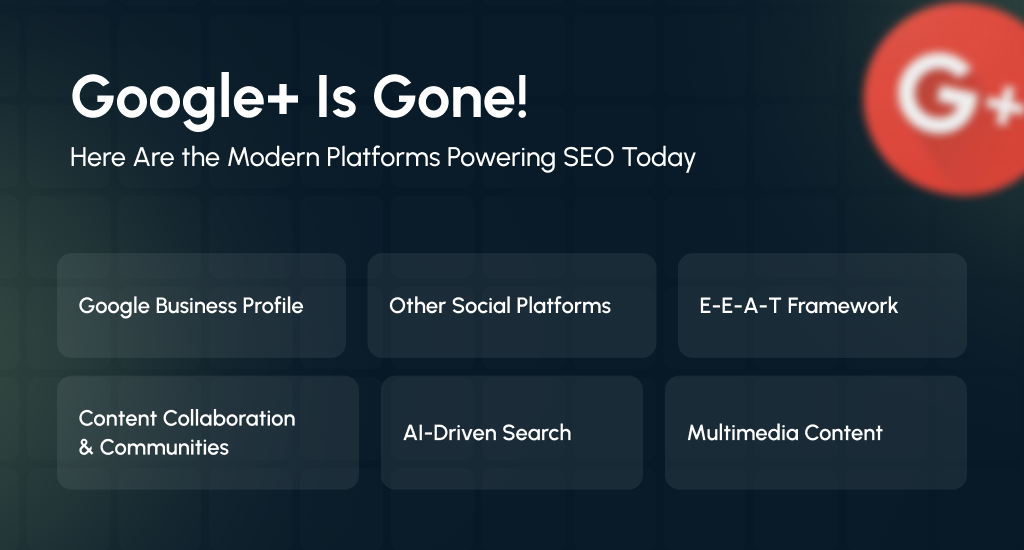
After Google Plus shut down, businesses had to find new ways to maintain visibility and improve SEO. Several tools and platforms now fill the gap. They are trying to help companies share content, build credibility, and reach audiences effectively.
Google Business Profile
Google Business Profile is now essential for local SEO. By keeping profiles updated with accurate business information, photos, and posts, companies can appear in local searches and Google Maps. It helps attract nearby customers and improves overall online visibility.
Other Social Platforms
Platforms like LinkedIn, Twitter/X, Medium, and Reddit let businesses promote content and engage with audiences. Sharing posts, articles, or updates on these platforms helps drive traffic to websites and build brand presence. Social engagement can indirectly support SEO by increasing referrals and visibility.
E-E-A-T Framework
Google’s modern SEO framework emphasizes Experience, Expertise, Authoritativeness, and Trust (E-E-A-T). High-quality and credible content with verified authors and proper references ranks better in search results. Strong focus on E-E-A-T helps businesses maintain proper authority online.
AI-Driven Search
AI-powered search features like Google’s SGE (Search Generative Experience) and AI Overviews are shaping how users discover information. Optimization of content for AI-driven results ensures relevance and visibility in new search formats.
Content Collaboration & Communities
Participating in niche online communities or collaborating with industry experts provides backlinks, shares, and engagement. These interactions help improve site authority and expand audience reach.
Multimedia Content
Engagement grows when businesses use videos, infographics, and podcasts on modern platforms. Rich media attracts clicks, boosts user experience, and can improve dwell time. Also, they can indirectly support SEO.
Final Thought
Google Plus may no longer exist for consumers, but its impact on search remains worth remembering. Google Plus for SEO showed how a social platform could influence visibility, trust, and reach. Businesses that used it wisely saw real improvements in rankings and brand strength.
While the tools have changed, the lesson stays the same: search engines reward platforms that connect content with users. What worked on Google Plus shows us how to build smarter SEO strategies moving forward. If you want to future-proof your online presence, you should start refining your SEO approach now.